Who Owns What You Read
Australia has one of the most concentrated media markets in the democratic world. This is who owns it, how it got that way — and how we would open it up, without silencing anyone.
1. The most concentrated market in the democratic world
Australia has one of the most concentrated media markets among established democracies; a 2016 study ranked its newspaper sector the most concentrated of 26 countries. News Corp Australia (around 59–65% of metro and national readership) and Nine (around 23–26%) dominate print, and News Corp, Nine and Seven together take roughly 80% of free-to-air and subscription television revenue.
2. How the rules were loosened
Each step was pitched as modernisation, and each enabled more concentration:
- 1987 (Hawke/Keating): cross-media rules — a company could control only one of three platforms (TV, radio, major newspapers) in a licence area, plus a TV reach cap. These governed cross-platform holdings; they never stopped one proprietor reaching ~70% of metro newspaper circulation.
- 1992 (Keating): the Broadcasting Services Act 1992 — the framework still in force — with foreign-ownership restrictions retained.
- 2006–07 (Howard/Coonan): foreign-ownership limits scrapped; cross-media relaxed to "two of three," with a voices test.
- 2017 (Turnbull/Fifield): removed the "two of three" rule and the 75% reach rule — enabling the Nine–Fairfax merger in 2018.
- 2021 onward: the News Media Bargaining Code and a diversity-measurement framework — support and measurement, not deal-gating. Foreign investment is now FIRB-reviewed, not capped.
3. Who owns what
Print and national news is dominated by News Corp Australia (US-incorporated; The Australian, the metro tabloids, news.com.au, Sky News Australia), Nine Entertainment (the largest Australian-owned group; SMH, The Age, AFR, Nine Network, Nine Radio), and Seven West Media (dominant in WA). Public broadcasters ABC and SBS remain among the most accessed and most trusted news brands. Beyond them sit a long tail of smaller and independent outlets — Guardian Australia, Crikey, Schwartz Media, The New Daily, and Australian Community Media's ~140 regional titles.
4. What "bias" can and can't be shown
Bias is real but hard to prove. The chart below plots news brands by the political lean of their audience — a proxy for, not a measure of, content bias, and a contested one.
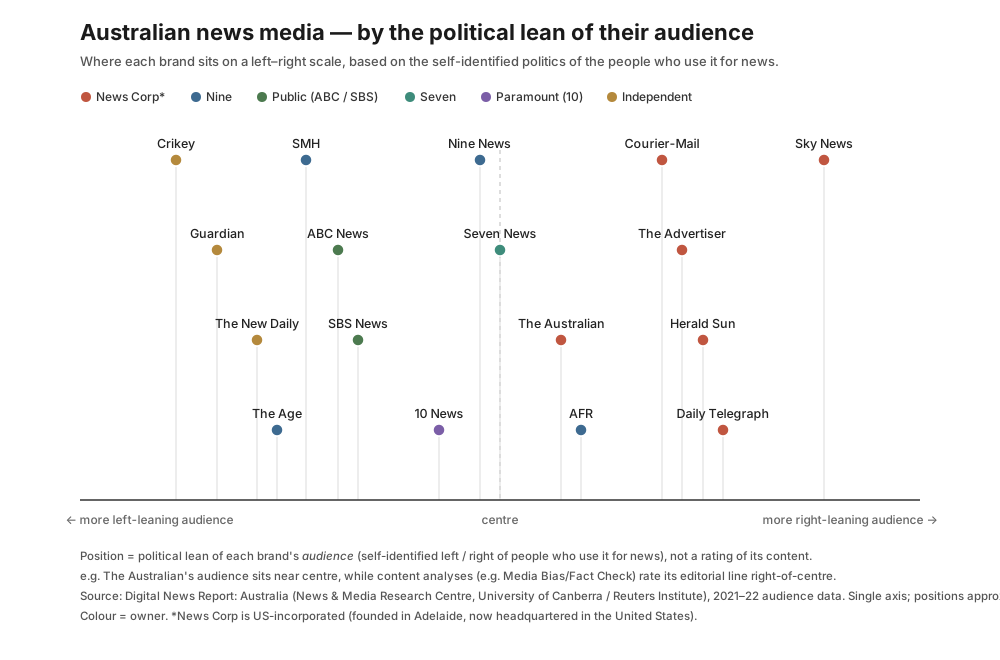
Content analyses of climate coverage, and independent bias raters, place some outlets right-of-centre; Australia's press-freedom ranking slid from 19th (2018) to 39th (2022). The honest position is to show the dispute: the same data is used to argue opposite conclusions.
5. The foreign dimension
Foreign ownership is no longer capped: News Corp is US-incorporated, and Foxtel was sold to the UK's DAZN in 2025. Separately, security agencies have documented foreign-state information operations — the national intelligence community has ranked foreign interference among its top concerns since 2022. The discipline is to target state conduct, never community loyalties, and to report the contestation honestly: who defines "manipulation" is itself a live dispute, and the finding can be misused to delegitimise legitimate dissent.
6. Advocacy and the nudge apparatus
Documented media-monitoring and complaint campaigns run across the spectrum — real activity, never "control," and small next to the ownership story. A quieter question is the institutional one: government behavioural-economics units ("choice architecture") now run hundreds of trials to steer citizens without regulation, and the larger nudge engine is commercial — platform recommender systems optimising engagement at population scale, with no consent framework.
7. A reader's bias gauge
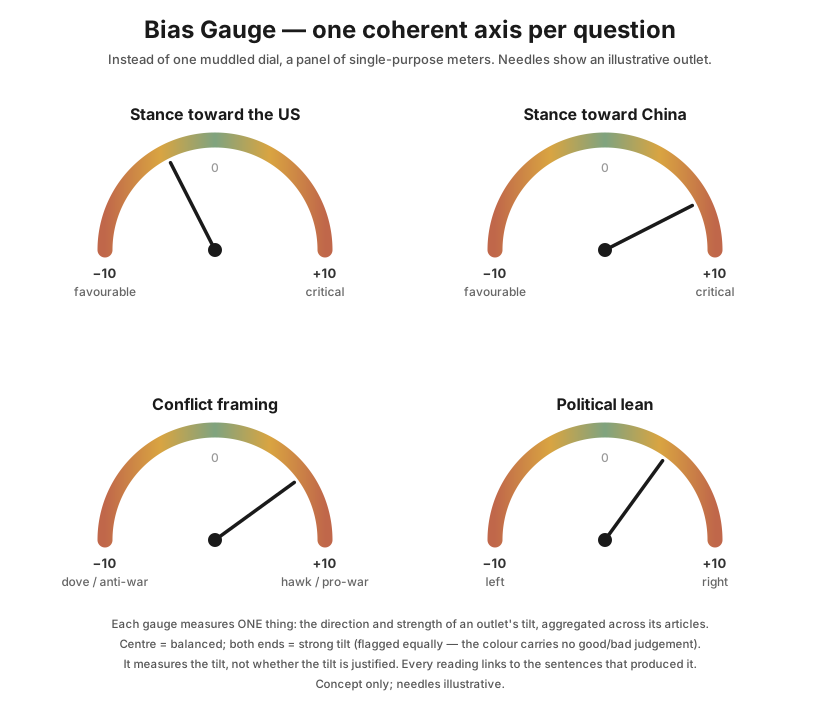
The suggestion is a tool that reads an outlet's or reporter's body of work and scores the slant of an article on clear, single-purpose gauges — favourable or critical toward a country, hawk or dove, left or right — with every score linked back to the text behind it. Two rules keep it honest: it measures the tilt, not the truth, and its method is open to inspection.
How we would repair it
- Break up the concentration — a 30% ownership cap on any single proprietor's share of the national news market.
- Open the books — transparent registers of media ownership and of lobbying and monitoring campaigns.
- Expose foreign-state influence — enforce registration of foreign-state media, targeting conduct, not communities.
- Hand readers the tools — back an open, auditable bias gauge so readers can see the slant for themselves.
Conclusion
Done well, a bias gauge does more than flag slant. It reminds the reader that what they are reading is one view among several — which is where open-mindedness begins.
Sources
- Australian Government, Broadcasting Services Act 1992 — the framework still in force; the retention of foreign-ownership restrictions at enactment; cited in section 2.
- Australian Government, Broadcasting Services Amendment (Media Ownership) Act 2006 — the removal of foreign-ownership limits and the relaxation of cross-media rules to “two out of three” with a voices test; cited in section 2.
- Australian Government, Broadcasting Legislation Amendment (Broadcasting Reform) Act 2017 — the repeal of the “two out of three” rule and the 75 per cent audience reach rule; cited in section 2.
- Australian Communications and Media Authority, Register of Controlled Media Groups and media control and ownership guidance — the current control positions and licence-area holdings underlying section 3.
- Australian Competition and Consumer Commission, Digital Platforms Inquiry final report (2019) and subsequent digital platform services reports — advertising revenue transfer from news publishers to platforms, and the recommender-system findings drawn on in section 6.
- News Corporation, annual report and United States Securities and Exchange Commission filings — the company's United States incorporation, cited in section 5.
- Foxtel Group and DAZN Group, transaction announcements (2025) — the sale of Foxtel to DAZN, cited in section 5.
- Australian Security Intelligence Organisation, Director-General's Annual Threat Assessment (2022–2026) — the ranking of foreign interference among the national intelligence community's principal concerns; cited in section 5, which states the contestation over the term rather than adopting it.
- Behavioural Economics Team of the Australian Government (BETA), published trial reports — the scale of government behavioural trials referred to in section 6.
- Reuters Institute for the Study of Journalism, Digital News Report: Australia — audience reach, trust measures and consumption patterns underlying sections 1 and 7.
- Australian Press Council and the ACMA co-regulatory codes — the complaint and adjudication mechanisms referred to in section 4, and the limits of what an adjudication establishes about systematic bias.