The SBC viaduct requires approximately 1.76 million pylon foundations across the national network. Conventional drilled-pier construction at 2-metre diameter cannot deliver this at the scale, speed, or carbon footprint the programme demands. So we engineered a new architectural system — the Anchor Tension System (ATS) — and we filed the patents in Australia, before a single pylon goes in the ground, so the IP belongs to the country that builds it.
Five patents have been filed at IP Australia between 24 April and 29 April 2026. All five protect distinct architectural innovations developed by Brett Murrell as part of the Moral Majority Party's SBC programme. All five are owned by Australians. The strategic intent is straightforward: the architectural primitives that make the SBC possible should be sovereign IP, not licensed from offshore.
The Pylon Design specification itself is published separately as defensive prior art — the design is freely available for use in Australian sovereign infrastructure. The patents protect the underlying architectural primitives — foundation, tensioning, multimodal viaduct topside — not the specific pylon design.
The Filings
Foundation Core
The integrated post-tensioned caisson foundation system. Drilled shaft (0.5–10m diameter, up to 100m+ deep) with precast reinforced-concrete ring segments that wedge radially under axial compression. Sacrificial cutter head with dual function — drilling tool during installation, permanent post-tensioning anchor afterwards. Retrievable tubular tension member using oilfield 13Cr L80 grade. Optional internal radial stabilisation packers in two installation modes.
- Sacrificial cutter head — permanent foundation anchor after drilling
- Precast ring segments — radial wedging under axial load
- Retrievable tubular — oilfield-grade tension member with axial-landing latch
- Optional radial stabilisation packers — internal bore reinforcement
- Top tensioning and locking assembly with re-tensioning across operating life
Integrated Foundation
Builds on Patent #1 with the full integrated tensioning architecture. Continuous tensioning architecture with packers for service life extension. Setting mechanisms for the radial stabilisation packers introduced in Patent #1. Inspection, retensioning, and replacement of the tubular tension member across full service life via standard oilfield wireline / coiled tubing service equipment.
- Continuous tensioning architecture across operating life
- Packer setting mechanisms — distributed-length axial anchoring
- Hybrid sacrificial cutter head — multi-material construction (steel / concrete / corrosion-resistant alloy)
- Multi-tubular post-tensioning — concentric nested capability for scaling tensile capacity
- Service-life inspection and maintenance via wireline / coiled tubing equipment
Foundation Drilling System
The mechanical engineering of the combined drilling-and-segment-installation pass. A distinct mechanical engineering invention separable for licensing — different invention category from the structural civil patents (P#1/P#2/P#4), separately patentable, separately licensable to equipment manufacturers.
- Combined drilling-and-segment-installation in single integrated machine pass
- Sacrificial cutter head release mechanism — decoupling at completion
- Variable bore diameter capability — modular cutter head sizing 0.5–10m
- External annulus grouting via integrated machine ports during drilling
- Ring segment placement and locking — axial keying, circumferential interlocking
- Continuous drilling through varied geology without tool change
Architectural Framework + Renewable Tension Element
The integrated architecture from foundation to cap beam. The renewable tension element is the central architectural innovation: the ability to inspect, retension, and replace the tubular tension member across the full 100-year service life. Modular precast caisson + pylon + cap beam stack. Application-independent cap beam upper surface — anything can be deployed on top.
- Renewable tension element — central architectural innovation
- Modular precast stack — caisson, pylon column, cap beam
- Application-independent cap beam — neutral platform for any superstructure
- No pile driving — drilled-and-grouted installation
- No embedded steel reinforcement — corrosion-resistant tubular tension member
- Reduced grout volume — engineered economy
- Mature oilfield tubular technology — proven service equipment ecosystem
Multimodal Viaduct Topside Architecture for ATS
The specific multimodal viaduct application of ATS. Paired-pylon arrangement on ATS foundations carrying multi-deck vertical service stratification — heavy services low, precision services high, configurable services middle. The freight-deck-borne self-platform construction methodology is the central architectural innovation: construction-during-operations capability over existing surface corridors with uninterrupted operation.
- Paired-pylon arrangement on ATS foundations
- Multi-deck vertical service stratification (heavy / precision / configurable)
- Cantilevered side service arms (HVDC etc.)
- End-feeding service installation methodology
- Future-level provision — designed-in capacity for upward extension
- Freight-deck-borne self-platform construction — central architectural innovation
- Construction-during-operations over existing surface corridors
- Multimodal dampening at all engineered joints (pin-and-socket / box-and-pin with elastomers)
Why five patents — defence in depth
The ATS Patent Family is not five attempts at the same invention. Each patent protects a distinct architectural primitive. Together they form a defence-in-depth IP structure that cannot be designed around without losing the engineering economics that make the SBC viable.
The generic foundation and tensioning framework. Broad coverage. Applicable to any elevated infrastructure — not tied to the multimodal viaduct application. Licensable independently.
The specific multimodal viaduct deployment of ATS. Paired pylons, multi-deck stratification, construction-during-operations. The application that the SBC programme uses.
A competitor designing around P#5 by going single-pylon hits P#4. A competitor designing around the foundation specifics of P#1 hits P#2 or P#3. No clean path around the family.
ATS (P#1–P#4) can be licensed independently of MM Viaduct (P#5). One for any elevated infrastructure use, one for multimodal corridor deployment. Two licensing tracks, not one.
Why this matters
Patents are not just legal instruments. They are receipts. They are evidence that the engineering exists, that someone has worked through it carefully enough to write it down in claim language, and that the work product is on the public record at a national patent office.
For the SBC programme, the patents serve four purposes:
The pylon foundation and viaduct architecture are not sketches. They are five documented engineering systems filed at IP Australia. Anyone can look up the application numbers. The receipts are public.
The IP for the largest infrastructure programme in Australian history is held by Australians, in Australia, before construction begins. Not licensed from offshore. Not sold to multinational contractors. Sovereign.
Once the SBC is operating, ATS can be licensed internationally to any country building elevated infrastructure. Australia exports the engineering, not just the minerals. The IP becomes a long-term sovereign revenue stream.
Filing now prevents anyone else from patenting around the architecture and forcing the SBC to license it back. The defensive position is locked before construction begins.
The filing strategy
Australia's provisional patent system locks the priority date at filing for $100 per application. Twelve months after each filing, a Complete Application is filed (typically with a patent attorney) which is examined and granted. International extensions via PCT can be filed at the 12-month mark to secure protection in other jurisdictions where the IP may have commercial value.
The MMP strategy was to file the SBC architectural IP early — and comprehensively — while the engineering was being refined for construction. Five patents filed across five consecutive working days locked the priority dates across the foundation, tensioning, and multimodal viaduct architecture before construction begins. When MMP forms government, the country has a portfolio of sovereign infrastructure IP already in hand.
PCT international filing deadline: 24 April 2027 — twelve months from the P#1 priority date. Decision on PCT route to be made before that date.
How the patents work in construction
The patent specifications are abstract by design — they protect the architectural primitives, not a single construction method. But the primitives have a natural embodiment: the rail-crane build sequence below shows how all five patents work together to put the structure in the ground. Four selected steps from the thirteen-step sequence:
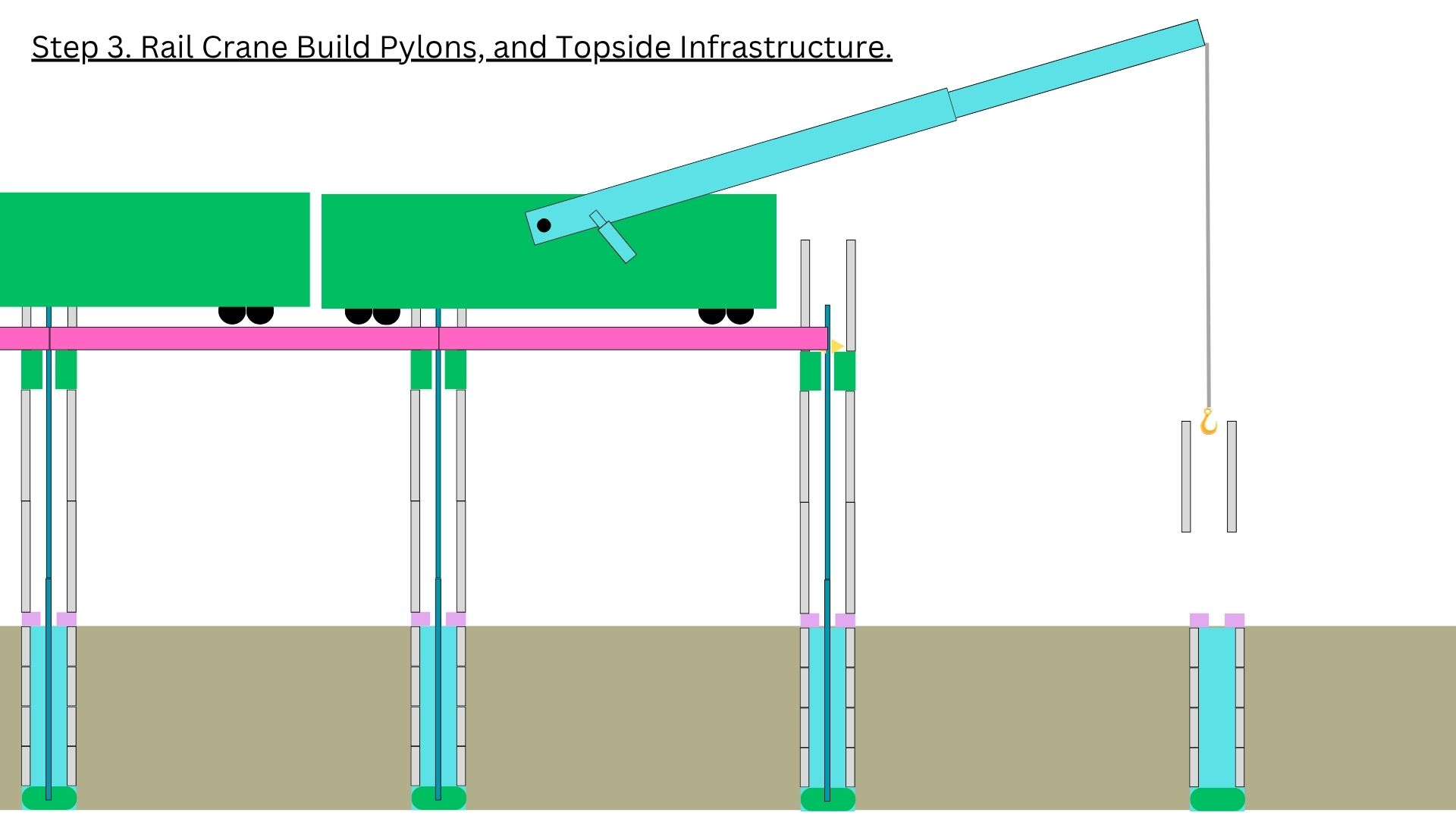
Rail crane lifts pylon legs into the prepared foundations. Patents #1, #2, #3 are already in the ground.
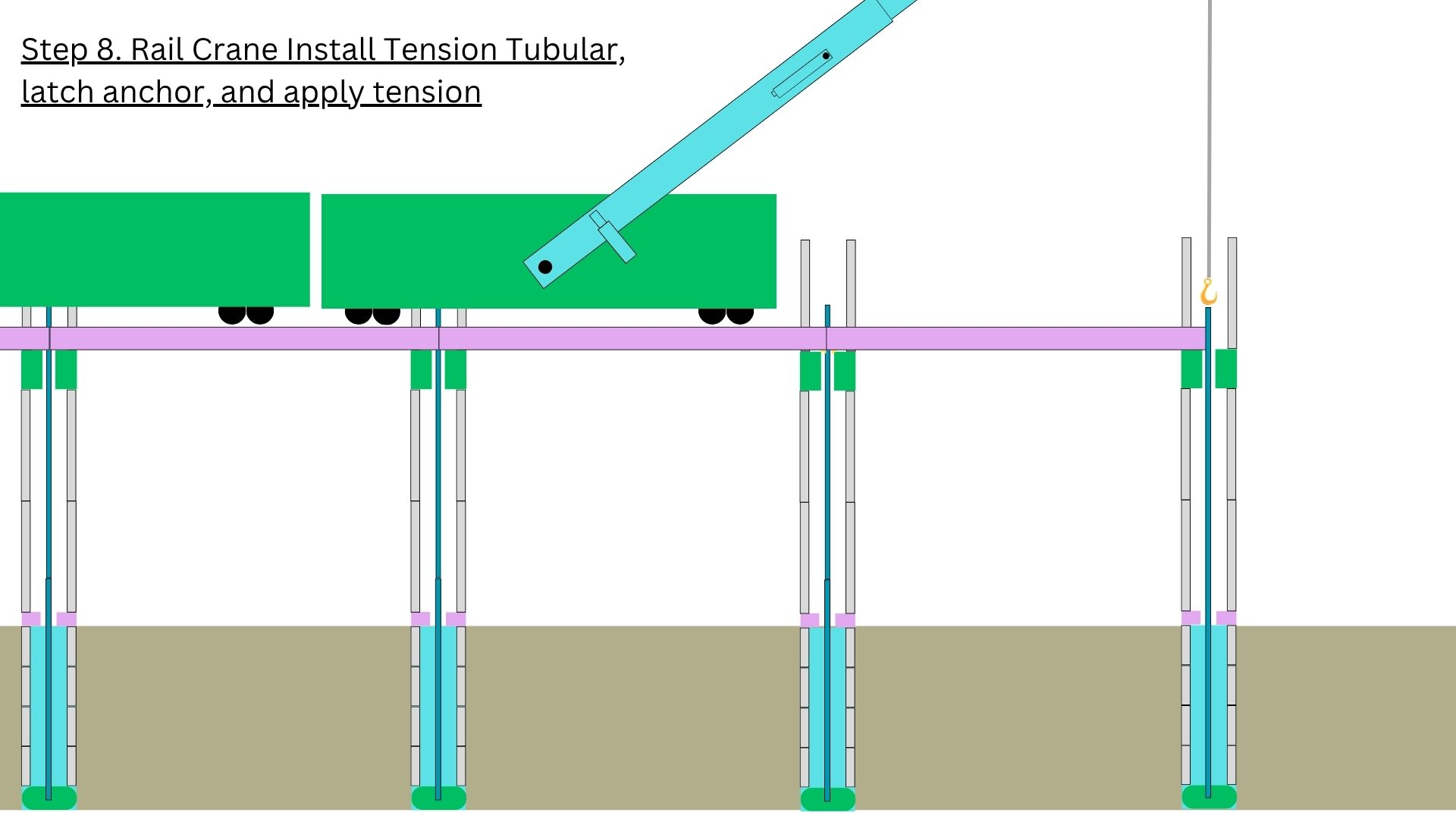
Tension tubular installed, latched, and tensioned. The Renewable Tension Element — the most novel ATS primitive — in its loaded state.
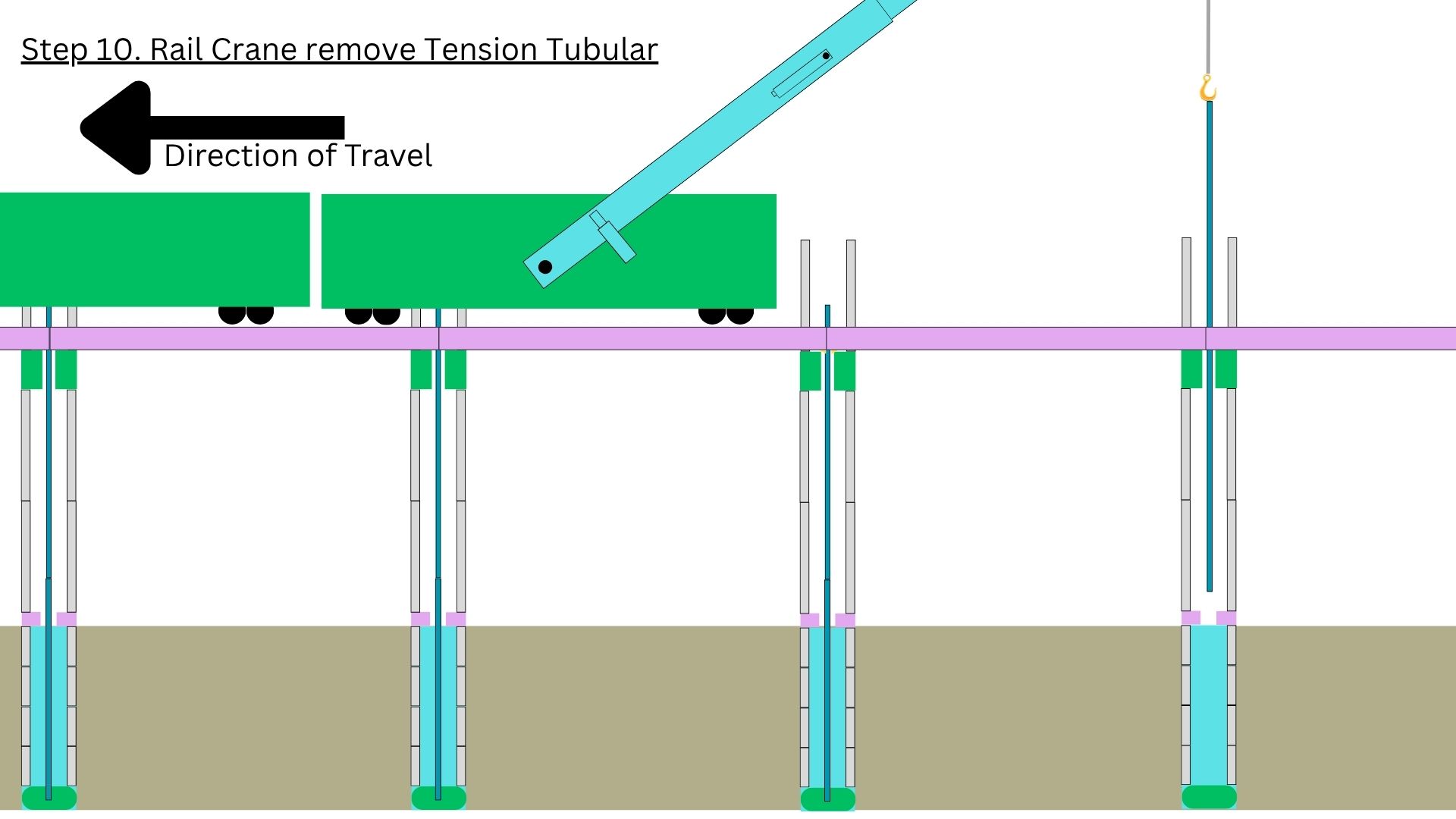
Tension tubular retrieved for re-use downstream. The “renewable” in Renewable Tension Element — one tubular, many spans.
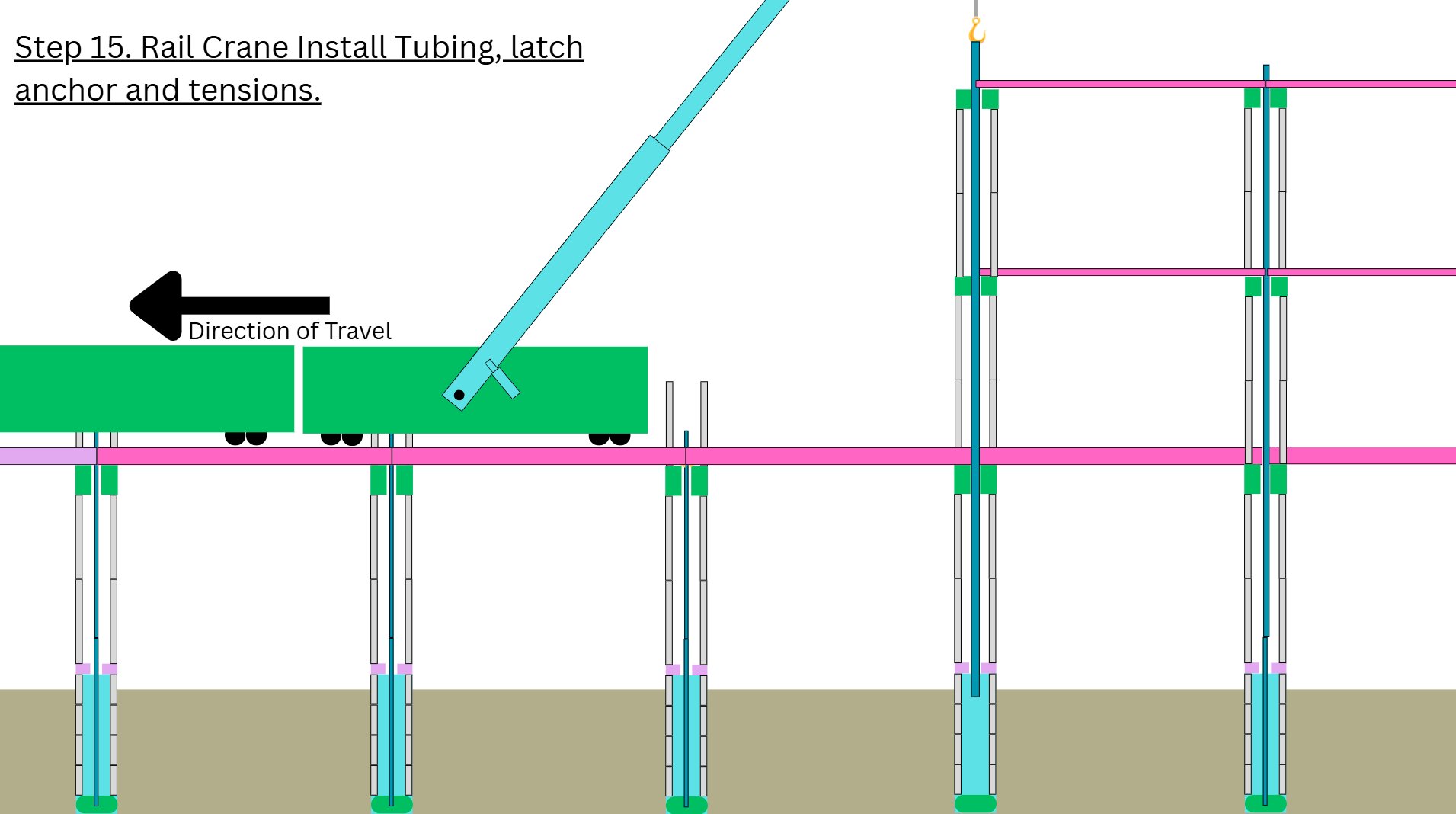
Multi-deck topside complete with upper-level tensioning applied. Patent #4 tension methodology repeats at every level; Patent #5 multimodal topside in its final loaded state.
See the full 13-step build sequence →
How to verify
The patent applications are public record. Any journalist, engineer, or curious citizen can search the IP Australia register at search.ipaustralia.gov.au. Search for any of the five application numbers:
- AU 2026903869 — Patent #1, Foundation Core
- AU 2026903952 — Patent #2, Integrated Foundation
- AU 2026903992 — Patent #3, Foundation Drilling System
- AU 2026904069 — Patent #4, Architectural Framework + Renewable Tension Element
- AU 2026904075 — Patent #5, Multimodal Viaduct Topside Architecture for ATS
The bibliographic data — applicant, inventor, filing date, title — is publicly viewable for all five applications.
Provisional patent specifications are not published in full at filing. They become publicly visible only at the 18-month publication mark or upon Complete Application. Until then, the existence of the application is public, but the technical detail is held confidentially by IP Australia. This is standard provisional practice and protects the inventor while the engineering is being refined.
What is verifiable today: the five applications exist, the priority dates are locked, the IP is owned by an Australian inventor, and the receipts are at IP Australia.
SBC foundation engineering → Pylon design specification → Build sequence → SBC overview →